
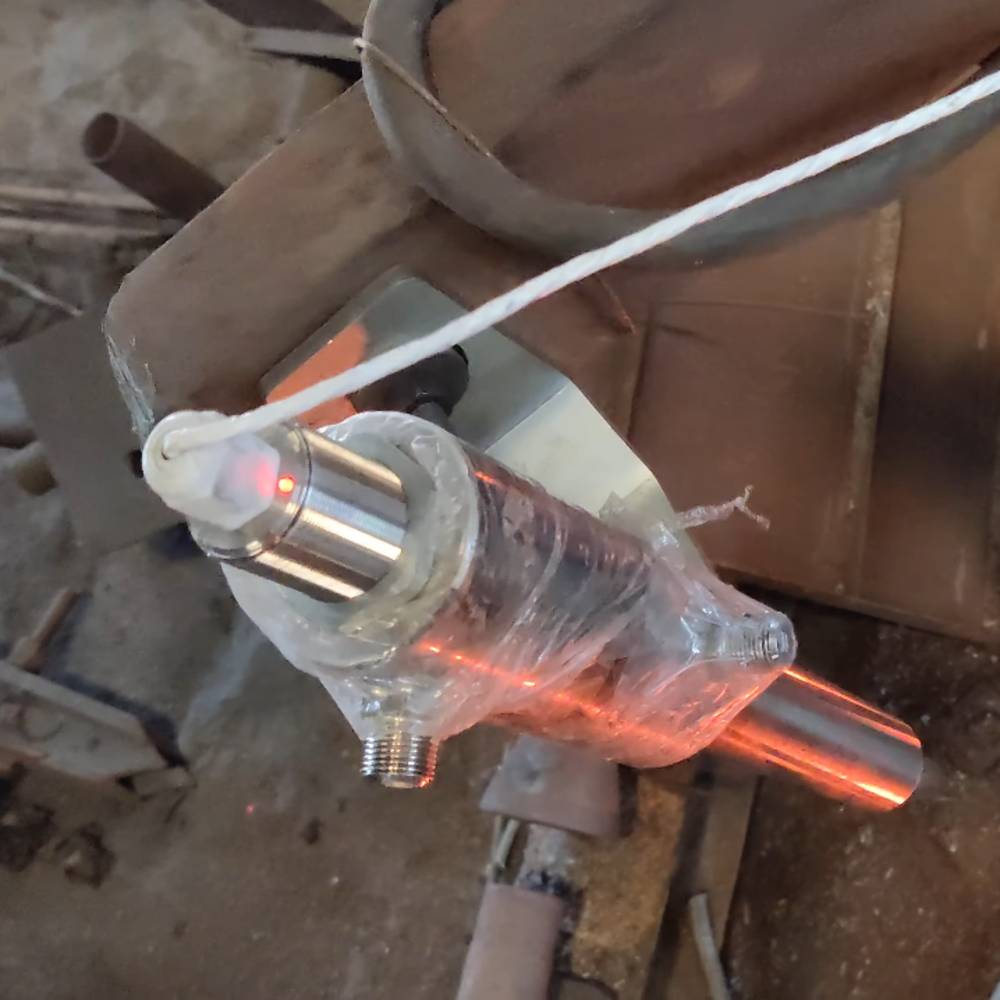
A hot metal detector (HMD) is a non-contact sensor that sees the infrared radiation emitted by hot steel and outputs a switching signal the moment a bar, billet or slab enters its field of view. Rolling mills use them to sequence stands, trigger shears, protect equipment and start timers — because at 700–1200 °C nothing mechanical survives near the pass line.
Quick reference
- Detects emitted infrared — no emitter, no reflector, no contact with the stock.
- Typical detection threshold from around 600–700 °C upward, adjustable by sensitivity setting.
- Response time in the low milliseconds, fast enough for high-speed rod and wire mills.
- Mounted off the pass line, sighting through a gap, with air purge and often water cooling.
- Main duties: stand-to-stand sequencing, shear triggering, cobble detection, loop control, mill-protection interlocks.
How a hot metal detector works
Every object above absolute zero radiates energy, and the hotter it gets the more it radiates and the shorter the peak wavelength becomes. Steel at rolling temperature — 900 °C to 1200 °C for most long-product mills — radiates strongly in the near and short-wave infrared.
An HMD is essentially a filtered infrared receiver with a lens and a threshold detector. Its optics define a narrow cone of view aimed across the pass line. Ambient mill structure, cool rolls and the housing itself radiate far too little at those wavelengths to register. When hot stock crosses the cone, the received energy jumps by orders of magnitude, crosses the threshold, and the output switches.
Two design decisions matter in practice:
- Spectral band. Narrowing the band to the short-wave infrared makes the detector far less sensitive to steam, water spray and scale dust, all of which are unavoidable around a mill.
- Field of view. A tight cone gives a crisp leading-edge signal and precise timing. A wide cone is more tolerant of stock wander but blurs the switching point.
Because it is a passive receiver, an HMD needs nothing on the other side of the pass line. That single fact is why it displaced through-beam photoelectric arrangements in mills: there is no emitter to align, nothing to be destroyed by a cobble, and no lens on the far side to keep clean.
What HMDs are used for in a rolling mill
| Duty | What the HMD does | Why it matters |
|---|---|---|
| Stand sequencing | Signals bar arrival at each stand entry | Starts the next stand at the right instant; prevents stand-to-stand tension errors |
| Shear triggering | Marks the leading edge for crop-cut timing | Crop length accuracy directly drives yield; a few milliseconds is several centimetres of steel |
| Cobble detection | Absence of expected signal within a time window | Stops the mill before a cobble wraps a roll or fills a guide |
| Loop control | Confirms stock presence in the looper zone | Enables tension-free rolling and dimensional consistency |
| Furnace discharge | Confirms billet has left the furnace | Interlocks pusher and roller table sequence |
| Cooling bed transfer | Counts and positions bars | Automates transfer without operators near hot stock |
| Roller table control | Presence and direction of travel | Reversing mill sequencing, table speed changes |
Two HMDs a known distance apart on the same table also give you a speed measurement for free: divide the separation by the time between leading-edge signals. Many mills use this as a sanity check against the drive encoder.
Mounting: where installations go wrong
An HMD is a simple device that fails almost entirely for installation reasons. Five rules cover most of it.
Sight across the pass line, not along it
Aim the cone perpendicular to travel so the leading edge produces a sharp transition. Sighting at a shallow angle along the direction of travel smears the switching point over a long distance and destroys timing accuracy.
Keep it out of the heat, and cool it anyway
Mount off the pass line behind structure wherever possible, sighting through a gap in guarding. Even then, the ambient near a hot mill will exceed the electronics rating. A water-cooled housing is standard practice on stands and near the furnace; on cooler parts of the line an air-cooled jacket may suffice. Check the housing rating against the actual measured ambient, not the nominal one.
Air purge the lens, always
Scale dust and oil mist will coat the optics within days. A continuous clean, dry air purge across the lens face is not optional — it is the difference between a sensor that runs for years and one that needs weekly cleaning. Feed it from an instrument air supply with a filter and, ideally, a flow switch that alarms if purge is lost.
Control the background
The cone must not see another hot object behind the target. A second strand, an adjacent furnace door, or a glowing roll in the background will hold the output on permanently. Add a physical baffle or shield behind the sight line where the geometry allows.
Plan for cobbles
Assume the mounting will one day be struck by tangled stock. Fit the head behind a sacrificial guard, run the cable in armoured conduit away from the pass line, and keep a spare on the shelf. In a mill, mean time to repair matters more than mean time between failures.
Setting sensitivity
Sensitivity sets the effective temperature threshold. Set it too high and cooler tail ends of the bar are missed — which shows up as intermittent faults at the end of a rolling campaign as the furnace drifts. Set it too low and the detector picks up hot scale on the table, radiant heat from adjacent equipment, or its own reflections off polished guarding.
The practical method:
- Run the mill and observe the signal margin with hot stock in view — you want a large, unambiguous swing, not a marginal trip.
- Observe the signal with the pass line clear but the mill hot, including immediately after a bar has passed.
- Set the threshold in the middle of that gap, then verify at the coolest stock you expect to roll, not the hottest.
- Re-check after a shift, once the housing has reached its steady-state temperature.
Where HMDs fit alongside other sensing
A rolling mill needs more than hot-metal detection. Cold stock at the entry end, on the cooling bed after the bars have lost their glow, and around handling equipment will not register on an HMD at all — that is what inductive proximity switches are for. Guarding, gate and access interlocks tend to use magnetic proximity switches, which sense through non-magnetic barriers and tolerate misalignment.
Roll gap and screwdown position, meanwhile, call for continuous measurement rather than a switch — that is the domain of linear position transducers. Because every one of these devices lives in scale dust and washdown, ingress protection is a first-order specification decision rather than a footnote — see our guide to what IP67, IP68 and IP69K actually test.
Frequently asked questions
At what temperature does a hot metal detector start to see the steel?
Most industrial HMDs are configured to detect from somewhere around 600–700 °C upward, with the exact threshold set by the sensitivity adjustment and the optical band. Rolling temperatures of 900–1200 °C are far above threshold and give a very large signal margin. If you need to detect stock that has cooled below visible red, an HMD is the wrong instrument.
Can a hot metal detector measure temperature?
No. An HMD is a threshold device — it reports presence or absence, not a value. Measuring the actual temperature requires a pyrometer, which is calibrated for emissivity and gives an analogue output. The two are often mounted near each other on a mill and are frequently confused, but they answer different questions.
Will steam and water spray cause false readings?
They can, which is why spectral band selection and lens purging matter. A short-wave infrared design is substantially less affected by water vapour than a broadband one, and a properly maintained air purge keeps the optics clear. Persistent false trips in a wet zone usually trace to a failed purge supply rather than the detector itself.
How fast is the response?
Low milliseconds for the detector itself. At a rod mill finishing speed the stock covers a significant distance in that time, so for shear triggering the total loop — detector, cabling, input scan and output response — has to be considered, not the sensor alone. Wire the HMD to a fast input or an interrupt, not to a slow scanned rack.
Where should the detector be mounted relative to the shear?
Far enough upstream that the control system has time to act at maximum line speed, and close enough that speed variation between detection and cutting does not accumulate into a length error. That distance is specific to your line speed, shear response time and required crop tolerance — it is worth calculating rather than copying from another mill.
Specifying hot metal detection for a mill? Accent Controls has supplied sensing equipment to Indian steel and metals plants since 1985 and builds hot metal detectors alongside our proximity and photoelectric ranges. Tell us the line speed, mounting distance and ambient conditions, and we will recommend the housing and cooling arrangement.
Discuss a mill application See the product range Technical support